Radios Don't Scale. Here's Why Transit is Switching to Push-to-Talk

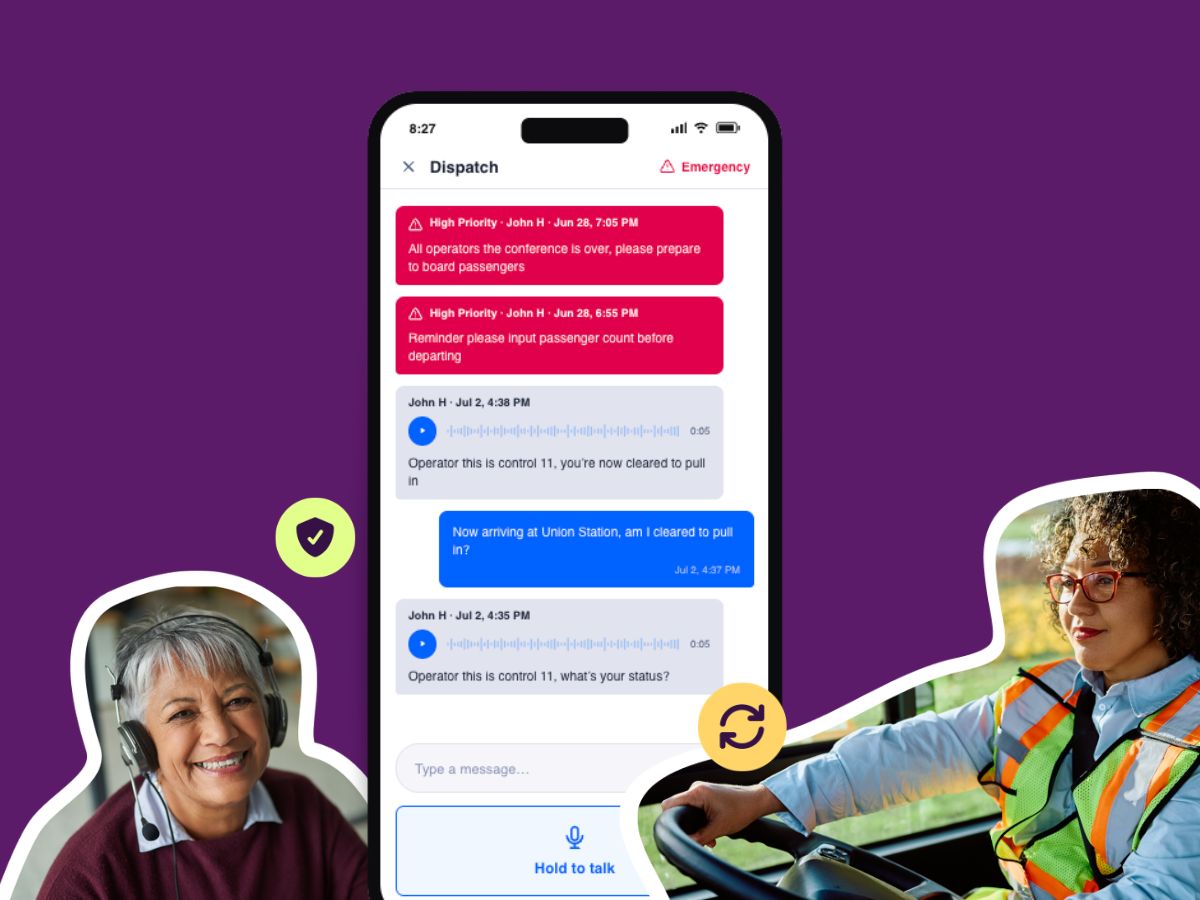
A dispatcher needs to reach a driver in real time. Instead, they’re juggling a radio, a phone, and sometimes a separate app just to get one message through. The driver isn’t better off. They’re focused on the road, and responding means picking up a device they shouldn’t be holding in the first place.
This isn’t edge-case friction. It’s the daily reality for agencies relying on tools that were never built for modern transit operations.
Why two-way radio breaks at scale
Radio works at a small scale: one channel, one dispatcher, a handful of vehicles. It breaks down as soon as an agency grows. Every message is broadcast to everyone, whether it's relevant or not. With legacy systems, there's no clean way to reach a single driver privately. And there's no reliable record. When an incident review comes down to "what did dispatch actually say," the answer lives in someone's memory, not in a system.
No record also means no reporting. Agencies running most legacy radio setups lack an integrated, searchable record tied to trip data, so there's no way to know whether dispatch is getting faster or slower, let alone prove it.
Radio also isn't as dependable as its reputation suggests. Coverage gaps, dead zones, and channel congestion mean messages get dropped exactly when service is busiest.
Even when the hardware holds up, radio remains limited by its voice-only nature. A driver who misses a specific address or a detour alert has no system of record to consult, leaving critical details to memory alone.
A more effective approach optimizes the medium for the direction of travel: while drivers communicate via hands-free voice, they receive incoming dispatch instructions as text that can be verified at the next stop. Legacy radio systems simply aren't designed for that level of operational clarity.
Costs scale poorly, too. More vehicles mean more hardware, more licensing, more overhead. When radio can't keep up, dispatchers reach for whatever workaround gets the message through, and those workarounds leave no record the agency can stand behind when there's a dispute.
Dispatch teams end up taking the blame for what are really tooling failures. No amount of training closes that gap.
Communication that understands trip context
.jpg)
Push-to-Talk is built directly into Spare Operations and the Driver App, so every message, whether voice, text, or emergency alert, is tied to real operational context: the driver, the vehicle, and the trip.
A radio call disappears the second it ends. A Push-to-Talk message stays. It keeps a record of who sent it, who received it, when it happened, and which trip it was about, and all of it lives in the system of record.
Dispatch and drivers communicate in the same system they already use to run service. No unnecessary hardware, no extra apps, no second login.
Driver workflow and hands-free safety
.png)
- Emergency response that cuts through: A one-tap alert with confirmation is designed to notify dispatch immediately, without accidental triggers. When a driver can't safely speak, a silent alarm sends the signal without drawing attention.
- Hands stay on the wheel: Drivers respond with a hands-free voice tool, and receive dispatch messages as text, so nothing depends on catching a garbled call in traffic. An instruction can be read back at the next stop instead of reconstructed from memory.
- One recorded channel: Every message sent through Spare is recorded and attributable. Nothing important travels through side channels that can't be searched later.
- A record for service improvement: Every exchange is searchable. That matters for incident reviews, but it also enables something more routine and just as valuable: understanding how dispatch communicates and improving it over time.
Replacing legacy tools: radio, walkie-talkie apps, and standalone tools
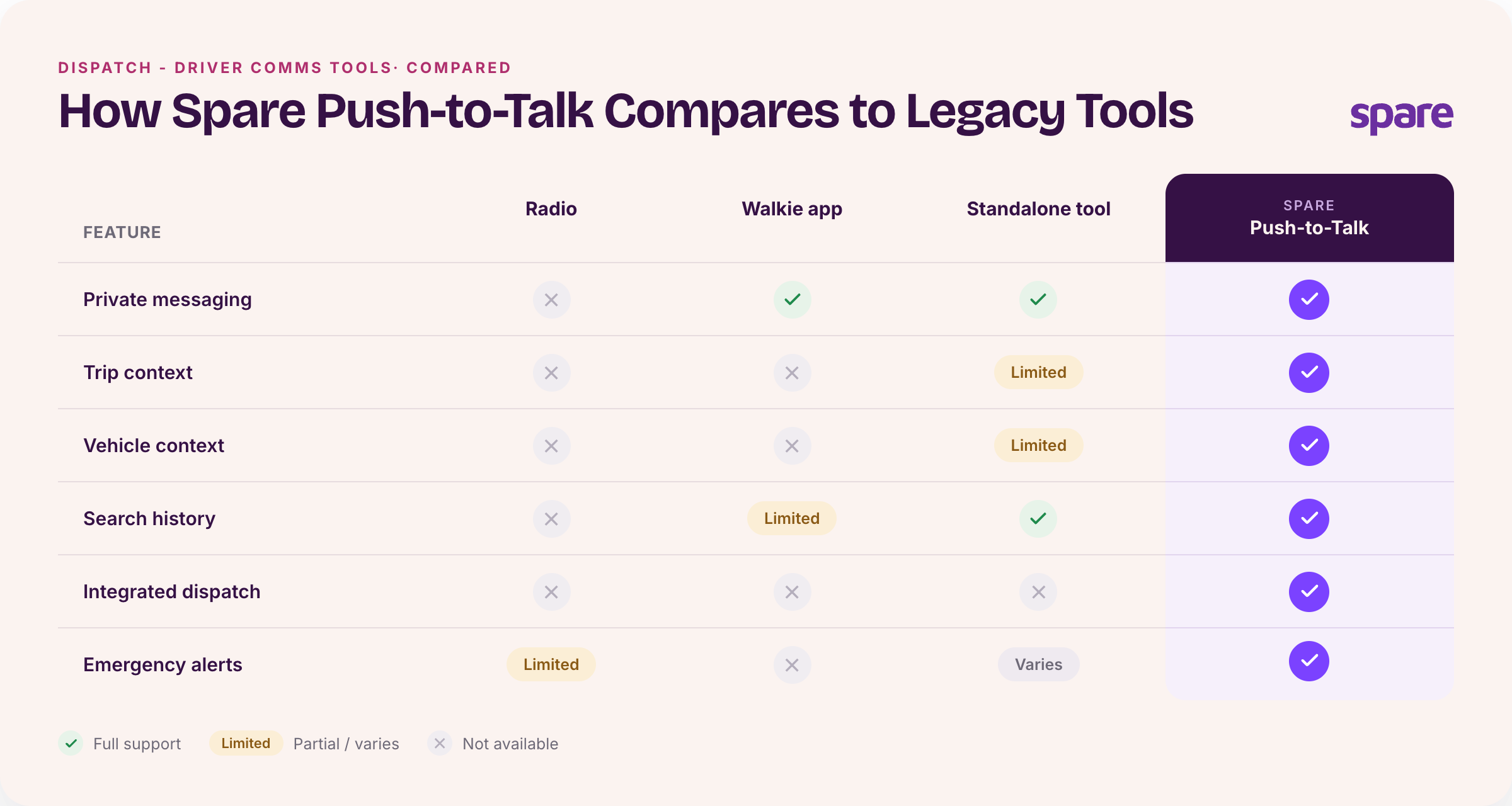
Compare radios, walkie-talkie apps, standalone transit tools, and Spare Push-to-Talk across the capabilities that matter most to dispatch teams.
Two-way radio still has niche uses, but it was never designed to be a system of record. It’s broadcast-only, lacks auditability, and becomes more expensive as fleets grow.
Walkie-talkie apps fix the broadcast issue but introduce a different problem: no operational context. They don’t know which trip a driver is on or who should be communicating with whom. That information has to be reconstructed elsewhere.
Standalone transit communication tools go further, but they still live outside the core operations platform. That means more integrations, more vendors, and more opportunities for data to fall out of sync.
Spare’s integrated Push-to-Talk rcan replace or consolidate these features with a single, recorded communication channel inside the platform agencies already use—one that carries full trip and vehicle context by default.
See Push-to-Talk in action
Push-to-Talk is in service at transit agencies today, moving real dispatch traffic with a full record behind every message. If your team is working around radio limitations, dropped coverage, or disconnected tools, get a demo to see what dispatch looks like when communication is built into operations, not bolted on.
.jpg)


From the blog
.png)


“Once we unified dedicated vehicles and TNCs on a single platform, the experience changed immediately for riders. They could see their trip in real time, understand their fare, and know what to expect. From a staff perspective, it eliminated confusion and allowed us to focus on service instead of troubleshooting.”