
Hamilton County Express Expands Access Through Smarter Scheduling

Reducing denials means we can be a trustworthy alternative to the automobile. It gives people more freedom, more flexibility, and confidence that they'll be able to get where they need to go.

Hamilton County Express Public Transit (HCE) provides reservation-based transportation throughout Hamilton County, Indiana, connecting residents to healthcare, employment, education, shopping, and other essential destinations. As one of Indiana's fastest-growing communities, demand for reliable transportation continued to increase, making it more important than ever for residents to have a service they could depend on to remain independent and connected to their community.
As ridership grew, HCE's previous scheduling system struggled to keep pace. Manual processes and batch scheduling made it difficult to respond to changing trip requests and cancellations, leaving staff to spend hours rebuilding schedules while riders repeatedly called for updates. Available capacity often went unused, even as other trip requests were denied.
The result was frustration across the operation. Managers spent much of their day reacting to scheduling challenges instead of improving service, dispatchers fielded constant status calls, and riders often couldn't be certain whether transportation would be available until just days before their trip.
As Senior Transportation Manager Ben Platz describes it:
"Managing the operation felt like riding a mechanical bull. We were just trying to hold on and get through each day."
HCE needed a way to make better use of existing resources while giving riders greater confidence that transportation would be there when they needed it.
A smarter approach to scheduling
HCE partnered with Spare to modernize its demand-response service through continuous scheduling optimization, improved rider communication, and self-service trip management. The objective was simple: make better use of every vehicle, reduce unnecessary trip denials, and create a more reliable experience for riders.
Instead of relying on static schedules that quickly became outdated throughout the day, Spare continuously optimized trips as new bookings, cancellations, and changing conditions occurred. Open seats created by cancellations could be automatically filled, helping the agency maximize existing capacity while keeping riders informed every step of the way.
The results were significant.
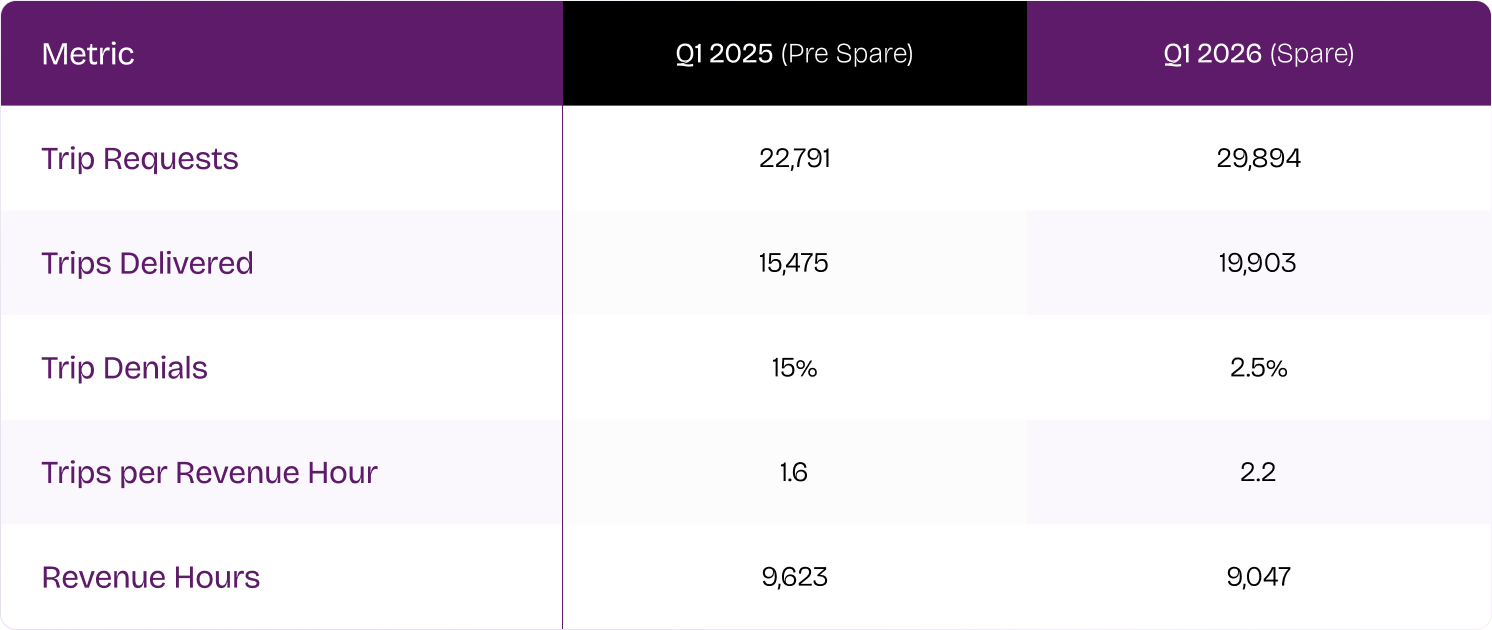
Rather than leaving vehicle capacity unused, Hamilton County Express was able to transport significantly more riders while using slightly fewer operating hours.
Continued growth
The growth didn't stop there. By August 2026, Hamilton County Express set new records for both demand and service delivered.
HCE delivered 8,370 trips in August, surpassing its previous monthly high of 7,774 in March 2026. Riders requested 12,153 trips, up from the previous record of 11,010 that same March.
More people were discovering the service, too. HCE welcomed 135 new riders in August, its highest monthly total on record. The new records show what increased capacity has made possible. As more residents turn to HCE, the agency has been able to serve that growing demand while continuing to keep trip denials low.
.jpeg)
More riders served. Far fewer denied.
Before implementing Spare, between 15% and 18% of requested trips were denied.
Today, the agency consistently maintains denial rates below 2%, even while trip demand has grown by roughly 30%. For riders, that means something much more meaningful than an operational improvement.
They represent confidence.
"Reducing denials means we can be a trustworthy alternative to the automobile. It gives people more freedom, more flexibility, and confidence that they'll be able to get where they need to go." - Ben Platz, Senior Transportation Manager, Hamilton County Express
Transportation Manager Teresa Franklin admits she was initially skeptical that technology alone could have such a dramatic impact.
"I was skeptical we'd ever see a world with very few denials. It tackled denials more than I could have imagined."
As reliability improved, so did public confidence in the service. Riders who once viewed demand-response transit as uncertain increasingly saw it as a dependable transportation option.
Giving staff time back
Dispatch call volume tells the story on its own. In Q1 2025, dispatch handled 4,839 calls. By Q1 2026, that dropped to 2,845, a 41% decline, even as trip demand grew 31% and ridership grew 28%. Calls also got shorter, down from 120 seconds to 89 seconds on average.
Reservations calls held closer to steady, rising slightly from 6,693 to 7,153, but average call length fell from 114 to 97 seconds. Without the HCE Rides app absorbing so many bookings, that line would have been far busier.
As one rider put it, "The app is really nice and helpful, it just sees your location of your work and your home address too."
Instead of spending the day answering status calls and manually adjusting schedules, managers could focus on training staff, supporting employees, and improving service.
Transportation Manager Teresa Franklin noticed the difference immediately.
"I used to come into 15-plus voicemails and the phone was ringing off the wall. Now sometimes I don't even have a call until 8:00, and there might not be any voicemails. It's a huge difference." - Teresa Franklin, Transportation Manager, Hamilton County Express
Drivers who once avoided learning dispatch responsibilities because of the stress now volunteer to cross-train, giving Hamilton County Express greater flexibility during service disruptions.
Confidence behind the wheel
The improvements weren't just visible to riders, they changed the experience for drivers as well. With more efficient scheduling, fewer manual changes, and better routing, operators spend less time dealing with unnecessary inefficiencies and more time serving riders.
One longtime driver summed up the difference this way:
"We've been here from the time they had paper sheets to this version. We're actually in heaven now in comparison."
Another added:
"The scheduling and efficiency are great, we don't have a lot of wasted time like we used to."
What this means for the community
Reliable transportation gives people the confidence to schedule medical appointments, get to work, shop independently, and remain active in their community. It helps people maintain their independence and reduces uncertainty in their daily lives.
"We are grateful to have the ability to use this service and friendly service," one rider shared.
One new Hamilton County Express driver recently shared a conversation with a rider that captured exactly what those improvements mean.
"She told me our service allows her to stay in her home because she can make it to her doctor's appointments. Otherwise, she'd have to be in a nursing home."
For Hamilton County Express, that is the true measure of success, not simply delivering more trips, but helping more people remain independent, connected, and active members of their community.