Forget the Technology. Here's How Three Agencies Actually Moved Riders Into Their Apps

.png)
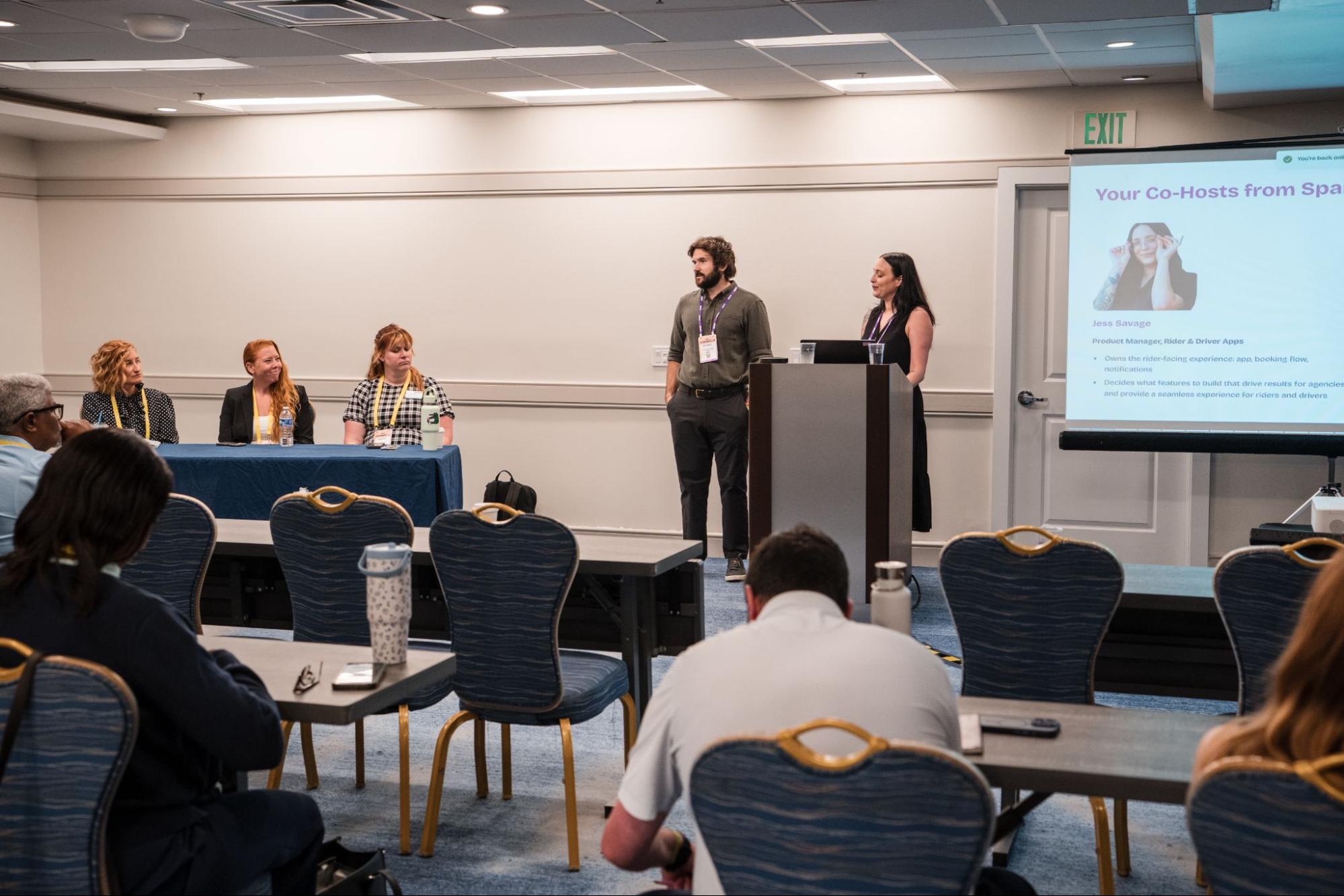
At Spare Connect Live 2026, we brought three transit agencies with proven track records to answer one question: how do you actually move riders into digital channels and keep them there?
PSTA (Pinellas Suncoast Transit Authority) now has 50%+ digital booking across paratransit and microtransit. Met Council scaled their microtransit program more than 10x in 18 months while maintaining 80% app adoption. Waco Transit doubled their adoption rate in six months.
Their answer challenges everything agencies think they know about adoption. And it has nothing to do with the technology itself.
The real barrier isn't the app. It's the first booking.
Transit trips are quietly load-bearing. For a dialysis patient, a caregiver, or someone without a car, missing one isn't just an inconvenience. It's a real problem. That's the weight behind the question these agencies set out to solve.
Once riders find the app and book successfully, they stay. Self-serve adoption climbs and doesn't slide back. PSTA has seen app usage grow every single year since launch. It has never gone down.
"Once they start using it, they realize it's easy. It gives them more freedom, more mobility. And then they're in." — Jessica Clark, Director of Marketing, Waco Transit System
The key insight is that riders don't leave after their first booking. The effort is front-loaded into getting them in the first time. Everything after that compounds.
The real blocker is outdated assumptions about who wants to go digital
Before tactics, the panelists addressed one mindset problem that still holds agencies back.
"78% of people over 65 own a smartphone and are actively using it. At 50 to 64, it's 90%. Don't make assumptions about what older riders want. Get to them and give them the choice." — Amanda Baird, Director of Communications and Marketing, PSTA
This single stat dismantles the conventional wisdom that paratransit and senior riders prefer the phone. They don't. What they want is independence.
Not "here's how to use the app," but "here's how to manage your own schedule without waiting on hold." For riders who have lost the ability to drive, or who live with disabilities, the app isn't a tech tool. It's autonomy.
PSTA's partnership with Lighthouse for the Blind proved this clearly. Visually impaired riders use the app to pre-book paratransit appointments, then switch to on-demand service for the unpredictable return trip, all within the same app. Riders spoke publicly about having jobs, living independently, and going to book clubs. Their quality of life was attributed directly to having control over their own transportation.
How they actually moved riders. The outreach playbook
None of the panelists credited a single campaign or feature for their adoption numbers. What worked was a combination of deliberate tactics, sustained over time, across many channels. They grouped into three clear patterns.
Tactic 1: Rider outreach at scale
Targeted direct mail
Most mailers get ignored because they land in the wrong hands. The key is precision. Reach only the people who can actually use the service, in the exact geography where it's available. A well-timed, specific piece of physical mail cuts through digital noise and creates a moment of awareness that sticks.
Agency example: Met Council mailed postcards exclusively to addresses within the geofenced service zone. One postcard drove a 300-rider spike, and it held. Ridership never dropped back to where it was before.
Community partner networks
Riders trust organizations they already have relationships with far more than they trust a transit agency. Rather than trying to reach every community segment directly, agencies can move faster by earning the trust of one anchor organization and letting them open the doors to everyone else.
Agency example: PSTA's partnership with Lighthouse for the Blind was the gateway. That single relationship led them to youth disability groups, senior buildings, and wheelchair-user communities they wouldn't have easily reached on their own. One trusted org became the connective tissue for an entire network.
Community-made videos
Agency-produced content can feel polished but impersonal. When local partners and real riders create the video, the authenticity shows, and audiences respond to it differently. The credibility comes from the fact that it looks and sounds like them, not like a marketing department.
Agency example: Met Council's city partners created their own how-to videos featuring real riders on real vehicles. Because the content was made by and for the local community, it carried more trust than anything the agency could have produced centrally.
Tactic 2: Meeting riders in the moment they're ready to book
In-person walkthroughs
Explaining how an app works rarely converts hesitant riders. Showing them, in the moment, on their own device, removes every barrier at once. The goal isn't to inform. It's to get someone through their first booking successfully.
Agency example: Met Council's outreach teams sit with riders, scan QR codes together, and walk them through their first booking in person. One 93-year-old rider now uses the app daily, because someone took the time to sit with him once.
Smart QR code placement
Context matters more than visibility. A QR code placed where riders already have their phones out, and already have a reason to book, converts at a completely different rate than a code on a bus shelter. The question isn't where you can put it. It's where someone is already in the right mindset.
Agency example: PSTA placed QR codes at the airport gate with a simple, specific message. "Book your ride to Clearwater Beach for $8." Tourists already have their phones out and a destination in mind. PSTA went further and placed an ad in the inflight magazine for Allegiant Air, the main airline into that airport, reaching riders before they even landed.
Hold message nudges
Riders who call in to book are already engaged. They just haven't made the shift to self-serve. A hold message meets them exactly in the friction point they're experiencing and offers an immediate alternative. It requires no new infrastructure and no active outreach.
Agency example: Waco Transit added a simple message to their phone hold queue. "You don't have to wait, you can book in the app right now." Passive, low-cost, and effective at redirecting callers who are already motivated to book.
Tactic 3: Staying connected after the first booking
Geofenced in-app messaging
Zone expansions bring new eligible riders, but those riders don't automatically know the service exists or how to use it. A targeted push message to exactly the right geography at exactly the right moment creates a direct, personal connection between a service change and the rider it affects.
Agency example: When Met Council expanded a service zone by two square miles, a geofenced push message to riders in that area drove an immediate ridership spike. They now treat geofenced messaging as standard practice for every zone expansion.
Two-week onboarding call
Newly approved riders are often overwhelmed by the eligibility process itself. Reaching them too early means they're not ready. Waiting too long means the momentum is gone. The two-week window catches riders when the approval is still fresh and they're most likely to be motivated to act.
Agency example: PSTA calls approximately 50% of newly eligible paratransit riders two weeks after approval. Not to sell them, but to check in, answer questions, and help them feel comfortable with the app. As they put it, you catch people on the wave.
The operational dividend and what agencies gain
When riders self-serve, dispatchers and schedulers have more time for the riders who need them most.
Waco Transit's dispatch team is less stressed. PSTA's AI voice handles approximately 50% of inbound calls without transferring to a human, bringing hold time to zero even for phone-only riders. The riders reaching a human agent are typically the ones who need a longer conversation, and now they get one.
"The people who aren't using the app are typically the ones who need more support. Now our dispatchers have time to actually give it to them." — Jessica Clark, Director of Marketing at Waco Transit
Measuring what matters
The metrics panellists track week over week:
- App adoption rate: What percentage of trips are booked without a phone call
- Ridership growth: Completed boardings, tracked week-over-week
- Customer satisfaction (NPS): PSTA tracks this alongside adoption as a leading indicator of retention
- Call volume reduction: PSTA has not filled three reservation agent positions since launching AI voice
Find your power users and let them do the work
Every agency on the panel had a version of the same story. One enthusiastic rider who becomes an unofficial ambassador.
One PSTA rider, a visually impaired consultant, uses on-demand service to visit every client and teaches each one how to book their own rides. A 93-year-old Met Council rider coaches his neighbor through the app from memory. When one person in a senior living community gets on, the whole building follows.
These riders are not just advocates. They're also your best source of product feedback. Their edge cases and specific requests tend to improve the experience for everyone. As one panelist put it, "Your riders are usually not wrong."
Three closing pieces of advice from the panel
Invest in outreach before you invest in anything else.
Thirty to ninety community engagements a year is normal for agencies seeing strong adoption. Two people can do it. The Heart (Houston) did over 90 community engagements in their first year. This is how you move the needle. Not with features. With presence.
Don't rush the transition.
Some services, especially paratransit and rural transit, take longer to shift digital. That's okay. The goal is sustainable adoption, not speed. Agencies that forced the transition too fast saw adoption plateau and then decline. The ones that stayed patient saw adoption compound year over year.
Don't assume. Ask.
Get to your riders, show them what's available, and let them tell you what they want. They usually surprise you, and they're usually right.
About the panelists
Amanda Baird is the Director of Communications and Marketing at PSTA (Pinellas Suncoast Transit Authority). PSTA launched with Spare in 2021 and has grown to 50%+ digital booking across paratransit and microtransit services, including AI voice.
Jessica Clark is the Director of Marketing at Waco Transit System. Waco launched with Spare in February 2025 and serves microtransit, paratransit, rural transit, evening link service, and Medicaid trips through a single platform.
Christina Fluger is the Project Administrator for Metro Micro at Met Council of the Twin Cities. Met Council launched their microtransit pilot in 2022 and has scaled to five zones with 6,500+ completed boardings per week and 80% app adoption.
About Spare One
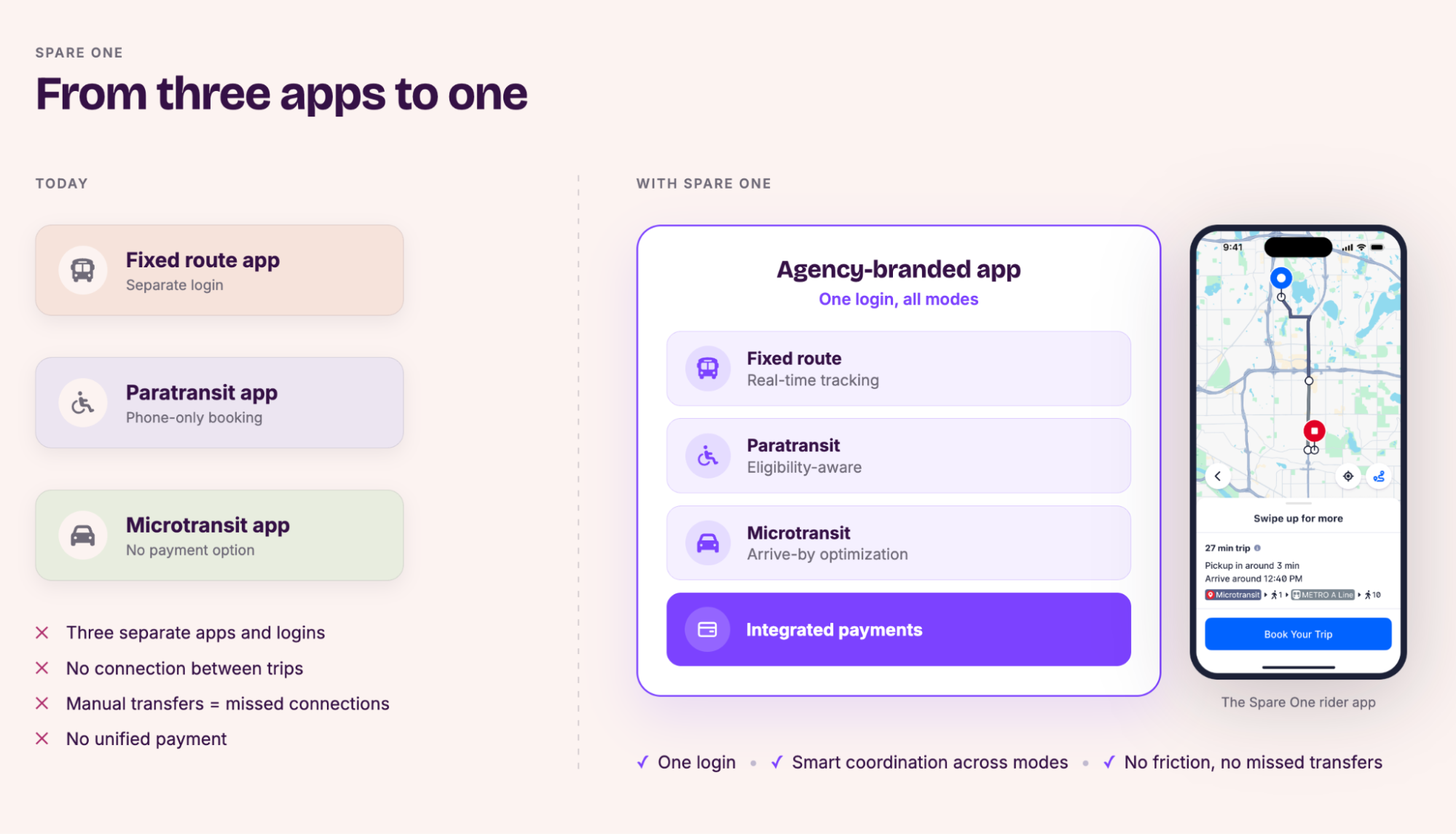
Most riders don't experience a transit network. They experience a collection of separate apps, disconnected schedules, and transfers they have to time themselves. Spare One changes that.
Spare One is the agency-branded rider app that unifies microtransit, fixed route, and paratransit in a single experience. Riders plan, book, and pay across every mode in one flow. Agencies own the brand, control the fares, and communicate directly with their riders.
What makes it different is coordination. Arrive-by logic actively times on-demand pickups with fixed route departures so riders actually make their connections. When conditions change mid-trip, service alerts go directly to the rider in real time.
For paratransit agencies, Spare One removes the choice between serving ADA riders well and serving the general public in the same app. Eligibility-aware booking means ADA riders get the right trip options in the same interface everyone else uses. No separate app. No two-tier experience.
The results: Metro Transit grew multimodal trips 4x. LA Metro increased ridership 34% without adding a fleet. The HOP saw a 31% increase in trip completion and a 20% drop in support calls.
Ridership grows when riding is easy enough that people actually do it.


From the blog


“Once we unified dedicated vehicles and TNCs on a single platform, the experience changed immediately for riders. They could see their trip in real time, understand their fare, and know what to expect. From a staff perspective, it eliminated confusion and allowed us to focus on service instead of troubleshooting.”