Why Integrated Platforms Matter for Modern Transit

Most agencies don't set out to run five vendors. It happens one point solution at a time. A scheduling tool here, a reporting add-on there, a maintenance system bought years before anyone thought about how it would talk to dispatch.
Each purchase makes sense on its own. Added together, they create a collection of disconnected systems instead of a technology foundation that matches the way service actually works.
Demand isn't waiting for agencies to catch up
In 2024, public transit agencies delivered 7.7 billion passenger trips, nearly 500 million more than the year before. Demand-response service has recovered to 93% of pre-pandemic ridership, faster than any other mode. None of that is slowing down. As populations age, more riders will depend on flexible, demand-responsive service.
Agencies are meeting that demand with fewer people to do the work. Roughly one in three transit positions is hard to fill, and budgets are growing flat to modest at best. A fragmented tech stack made of five disconnected vendors was hard to justify when times were easier. It's much harder to defend when demand keeps climbing and staff don't.

The real cost isn't the software
When agencies talk about the cost of a fragmented tech stack, they usually start with licensing fees. But the bigger cost is what happens after the contracts are signed.
Someone has to keep the systems talking to each other. Someone has to reconcile data when two platforms disagree. Someone has to explain why the ridership numbers in one report don't match the numbers in another. That work falls on staff who could otherwise be focused on service.
Agencies running several vendors describe a familiar pattern. Systems that don't talk to each other. Teams spending more time maintaining integrations than improving service. Reporting that takes days instead of minutes because the data lives in five different places.
It's not just fewer tools, it's one network
Consolidation is where the conversation usually starts, but it isn't where the value ends. When planning, dispatch, rider information, and every mode of service run on the same platform, an agency isn't just cutting vendors. It's operating one connected network instead of a set of isolated modes.
That distinction matters more as agencies take on more service types. Fixed route covers the core corridors. Microtransit reaches neighborhoods a full route can't justify. Paratransit serves the riders who depend on it most. These services support the same community, but on separate systems, they can't see each other. A vehicle running under capacity on one mode can't help cover a gap on another. A pattern showing up in paratransit denials doesn't reach the planners rethinking a fixed route.
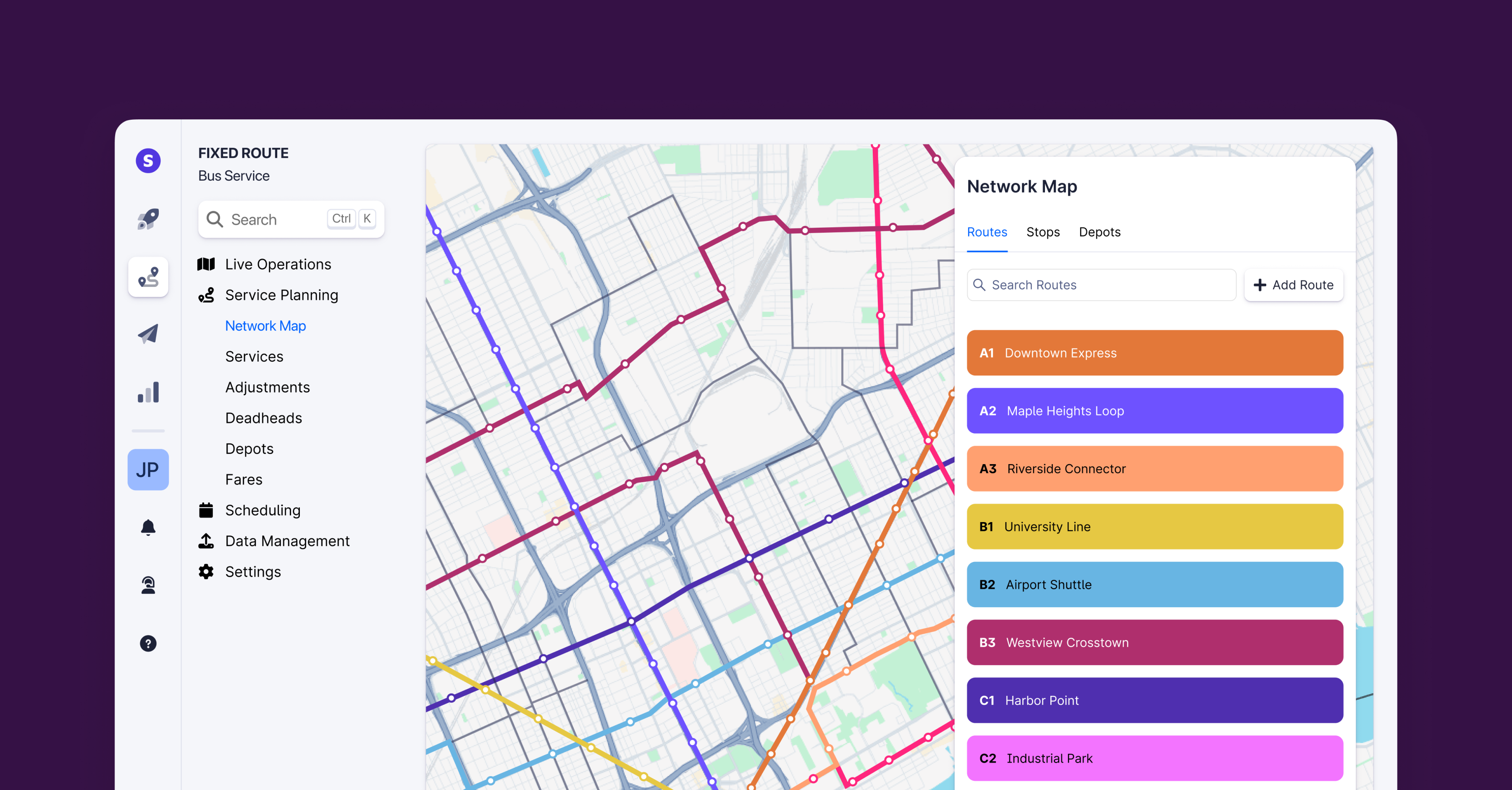
A unified platform closes that gap. Planners design routes on the same live map that dispatchers watch and drivers navigate. Every mode reports into the same operational picture, so a schedule change, a service disruption, or a shift in demand shows up everywhere at once, not just in the system where it happened.
One vendor, fewer places for risk to hide
Running two platforms instead of one usually means redundant licensing, duplicate training, and payment processes that have to be stitched back together by hand. Federal guidance has flagged these exact risks for agencies weighing multi-vendor setups.
The alternative is simpler to describe and easier to defend. One booking interface, one dispatch environment, one payment system, one reporting structure, one accountable vendor, one rider-facing experience.
That simplicity matters to riders too. A single unified intelligence layer means riders can access every service an agency offers in one place, instead of juggling separate apps for separate modes.

The silo problem goes beyond scheduling
Fragmentation isn't limited to booking and dispatch. Operations and maintenance teams are supposed to work from the same information, but on legacy systems, they often don't. Spare EAM was built specifically to close that gap, so inspection data, work orders, and vehicle status are visible across the organization instead of trapped in the maintenance office.
That connection shows up in the numbers. At Gulf Coast Transit District (GCTD), unifying asset management with day-to-day operations meant no more going through multiple systems to figure out which vehicles were road ready. Their Deputy Executive Director, Lacey Hernandez put it simply: “Everything's combined so we're no longer spending time going through multiple systems and it’s made our jobs ten times easier." GCTD completed more inspections and had more vehicles available for service as a result.
What the ROI actually looks like
The case for integration gets stronger when you look at what happens after a single feature goes live inside a connected platform, rather than as a standalone add-on.
Collin County Transit unified its brokered-trip operations on one platform and cut its cost per ride by 52%. Monthly boardings grew by over 1,000% in the same period. Citibus in Lubbock combined microtransit and paratransit trips on shared vehicles within a single platform, opening up hundreds of daily trips to medical facilities and job centers that would have been harder to coordinate across separate systems.
None of these results came from one clever feature working in isolation. They came from features that could see and act on the same data, because they lived on the same platform.
Why AI needs a unified platform to work
AI gets talked about as if it's the differentiator on its own. It isn't. AI is only as useful as the data it can see, and in a fragmented stack, no single tool sees the whole picture.
On a unified platform, AI can spot a transfer opportunity between fixed route and microtransit, flag a maintenance issue before it takes a vehicle out of service, and surface a reporting anomaly before it becomes an audit finding.
None of that is possible when the relevant data is locked in three separate systems that were never designed to compare notes. The platform is what turns AI from a feature into an operational advantage.
One flag, five updates, no phone calls
Here's what that looks like on a real morning. A rider books a paratransit trip. During the pre-trip inspection, the wheelchair lift on a vehicle assigned to a fixed route is cycling slowly, and a technician flags it.
On a fragmented stack, that flag stays in the maintenance system until someone happens to check it. On a unified platform, one approval sets off a coordinated response. Driver manifests update on both the fixed route and paratransit vehicle. Riders get accurate pickup times by app, text, or AI Voice. A maintenance work order opens with the inspection notes already attached. Planning sees the pattern later, before it turns into the next breakdown.
The rider just arrives on time. They never know a lift was flagged, a vehicle was swapped, or a work order was opened on their behalf. That's what one network moving as one system looks like in practice, and it's not possible when the same information is split across three tools that don't talk to each other.
Why this matters most when budgets get tight
Every agency eventually faces a budget review. The agencies in the strongest position are the ones whose technology isn't itself a source of risk.
A fragmented stack is hard to defend in that conversation. It's difficult to show a clean cost picture when spending is spread across five contracts. It's difficult to explain a service gap when the root cause is two systems that don't share data properly.
A unified platform gives agency leaders a much simpler story to tell. One system, one source of truth, one vendor accountable for the outcome. That's not just easier to manage day to day. It's easier to defend when the budget conversation gets hard.
The bottom line
Point solutions solve one problem at a time, but they create a bigger one in the process. Every new vendor adds another integration to maintain, another dataset to reconcile, and another place for something to break.
The agencies pulling ahead aren't the ones with the most tools. They're the ones operating a single connected network, where every mode, every asset, and every rider interaction feeds the same operational picture.
That's what turns a good feature into a lasting advantage, and it's what gives agency leaders a stronger case to make when it counts.




“Once we unified dedicated vehicles and TNCs on a single platform, the experience changed immediately for riders. They could see their trip in real time, understand their fare, and know what to expect. From a staff perspective, it eliminated confusion and allowed us to focus on service instead of troubleshooting.”